Smart Governance Without the Red Tape: The Rise of Ad-Hoc Boards
A practical framework for creating flexible, non-statutory governance bodies that sharpen strategy without shifting control.
Many companies eventually reach a point where traditionalgovernance bodies—shareholders’ meetings, statutory management, and formalboards—no longer provide sufficient strategic support.
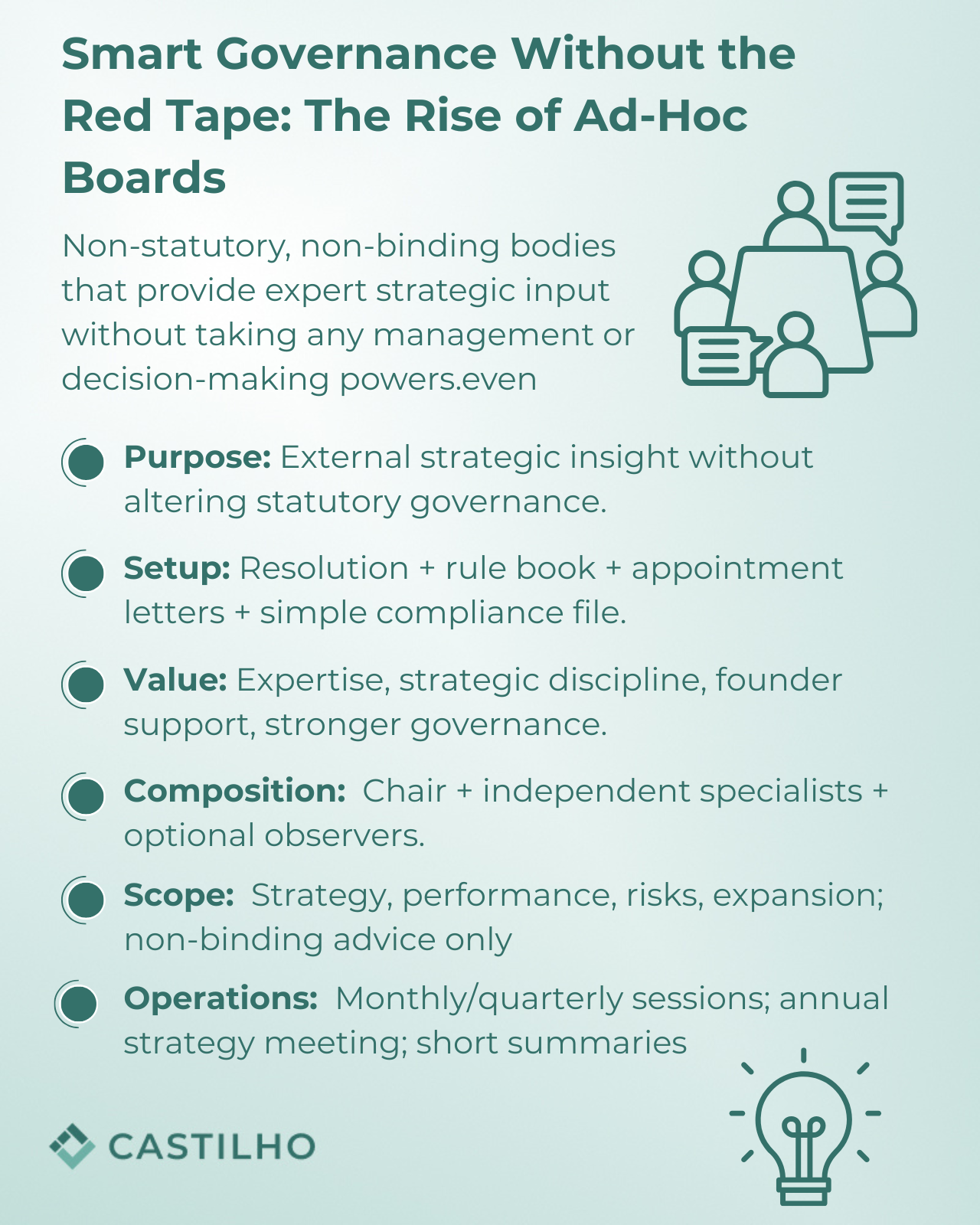
To address this, organisations create non-statutory,flexible governing bodies such as ad-hoc boards, strategic committees,expert panels, and project-specific working groups.
These structures offer high-level expertise, reinforcestrategic discipline, and support founders without undermining managerialauthority.
1. How These Bodies Are Set Up
Although flexible, ad-hoc governance bodies must be createdthrough a clear corporate process:
a) Formal Corporate Resolution (Acta / Minutes)
A shareholder or board resolution formally establishes the body, defining its nature, purpose, non-binding character, and approving its internal rules.
b) Internal Regulation / Rule Book
A concise document sets out purpose, scope, composition,mandates, competencies, operating rules, confidentiality and conflict-of-interest standards, and record-keeping obligations.
c) Individual Appointment Letters
Each member receives an appointment letter confirming the consultative role, independent-service status, duties, confidentiality rules,conflict-of-interest obligations, and remuneration terms.
d) Record-Keeping & Compliance File
The company maintains the founding resolution, regulations,signed appointment letters, agendas, reports, attendance records, and declared conflicts to ensure full compliance and audit readiness.
2. What Is an Ad-Hoc Board?
An ad-hoc board is a non-statutory, consultative body designed to provide structured external insight on strategy, performance, and long-term initiatives.
It does not hold decision-making or representation powers and cannot bind the company.
3. Why Companies Create These Bodies
- Expertise without full-time hires: Access to senior knowledge in key areas.
- Strategic discipline: Regular meetings force structured planning and review.
- Founder support: A sounding board for complex decisions.
- Investor confidence: Strengthened governance and due-diligence readiness.
4. Composition and Appointment
A typical ad-hoc board includes:
- A Chair/President, responsible for meetings and follow-up.
- Independent specialists, providing external insight.
- Observers, such as founders or executives, without membership duties.
Appointments are formalised through nomination contracts.
Terms often last 1 year for members and 3 years for the Chair,renewable unless terminated.
5. Core Competencies
Ad-hoc boards focus on strategic—not operational—matters:
- Reviewing annual and multi-year strategy.
- Analysing performance and expansion plans.
- Assessing major investments and risks.
- Advising on culture, leadership, and organisational design.
- Issuing non-binding recommendations.
6. Operating Model
Typical rhythms include:
- Monthly or quarterly sessions for updates and reviews.
- An annual strategy meeting to set next-year priorities.
Meetings may be in-person or remote. The Chair preparesagendas and concise post-meeting summaries.
7. Remuneration Models
Most companies use a per-meeting fee, maintainingindependence and avoiding employment-law risk.
Members invoice the company directly and handle their own tax and social security obligations. VAT treatment depends on their residency.
8. Duties of Members
Members must:
- Act independently and impartially.
- Prepare adequately.
- Maintain confidentiality.
- Declare conflicts in advance.
- Refrain from managerial, representational, or operational acts.
- Avoid acting as de facto directors.
Serious or repeated breaches allow immediate removal.
9. Beyond Ad-Hoc Boards: Other Structures
Companies often create additional bodies such as:
- Investment Committees
- Risk Committees
- Brand/Product Councils
- Market-Entry Panels
- Transformation Steering Groups
All share the same principles: specialised, non-binding,flexible, strategic.
10. Conclusion
Ad-hoc boards and other flexible governance bodies helpcompanies scale responsibly, strengthen decision-making, and access specialised expertise—without modifying statutory governance or shifting managerial authority. They provide structure and oversight while keeping accountabilityfirmly with management and shareholders.