Contractual Joint Ventures in Portugal: The “Associação em Participação”
A flexible contractual structure allowing investors to share in business results without creating a company or holding equity.
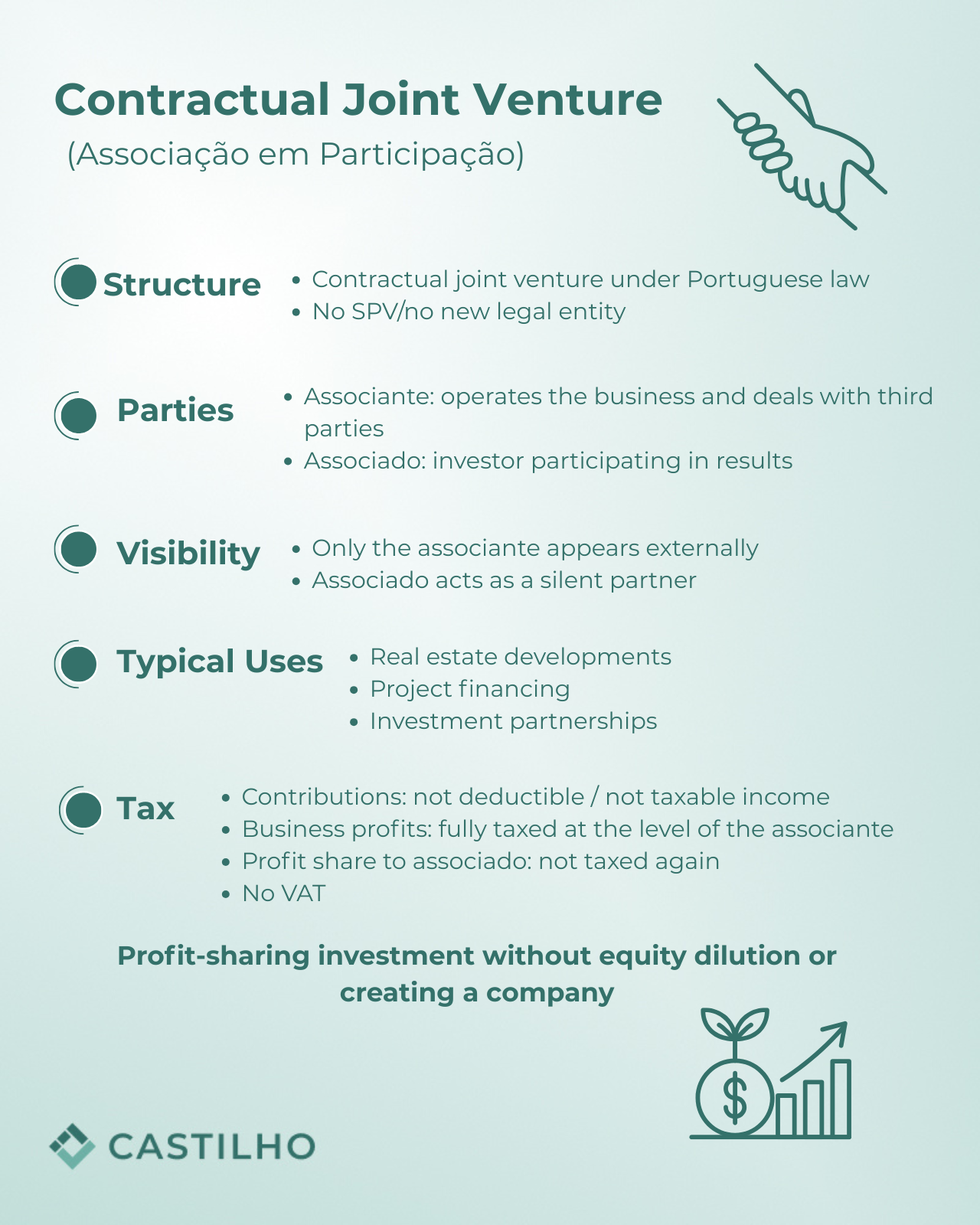
A contractual joint venture, known in Portugal as an “associação em participação”, is a flexible legal structure used by businesses and investors to collaborate on a specific economic activity without creating a new company.
It allows one party to operate the business while another participates economically in the results of that activity, without having to setup a common SPV. The structure is widely used in real estate development,investment partnerships, and project financing, where investors prefer to remain outside the formal corporate structure.
What Is an“Associação em Participação”?
An associação em participação is a contractual arrangement where one party (the associante), who carries out an economic activity, allows another party (the associado), to participate in the results of that activity. The associated party typically contributes capital or other assets in exchange for a share of the profits.
Key features include:
- No new legal entity is created
- The business is carried out only by the associante
- The associado participates in profits (and optionally losses)
- The relationship exists purely through contract
In essence, it is a profit-sharing partnership without corporate formalities.
The Two Parties: Associante vs Associado
Associante
The associante is the party that carries out the economic activity and interacts with the market.
Responsibilities typically include:
- Managing the business activity
- Contracting with third parties
- Bearing operational responsibility
- Reporting results to the associado
Externally, the associante appears as the sole owner and operator of the business.
Associado
The associado is the participating investor or partner.
Typical characteristics:
- Contributes capital or assets to the activity
- Participates in profits (and sometimes losses)
- Usually has no direct relationship with third parties
- Often remains “hidden” from the market
Because of this structure, the associado is sometimes referred to as a silent partner.
Key Legal Characteristics
Several elements define a valid associação em participação:
- Existing economic activity
The associante must carry out an economic activity. - Participation in profits
The associado must participate in the profits of that activity. Participation in losses is optional but may be agreed. - Contribution by the associado
The associado must provide a contribution, usually financial. - No joint ownership of the business
The activity remains entirely owned and operated by the associante.
Because of these characteristics, the arrangement does not create a company, partnership, or separate patrimony.
Governance and Control
The associante retains control of the business.
However, the contract can establish:
- Information rights
- Approval rights for key decisions
- Reporting obligations
- Profit-distribution mechanisms
The associante must also manage the activity prudently and present accounts to the associado, allowing the investor to verify the results.
Typical Uses in Practice
The associação em participação is commonly used in situations where:
Real estate projects
- A developer carries out a project
- Investors finance development
- Profits from sales are shared
Project financing
- Investors participate economically without becoming shareholders
Professional activity restriction
- Where regulatory rules prevent third-party ownership
Investment structures
- Where investors prefer anonymity or limited exposure
Because the associado does not appear publicly, the structure allows investors to participate economically without becoming formal shareholders or partners.
Tax Treatment (Overview)
Portuguese tax authorities generally treat the structure as follows:
Contribution by the associado
- The contribution made by the associado is not a tax-deductible expense, as it represents an investment.
- It is not taxable income for the associante.
Business profit
- The associante is taxed normally on the full business profits, under the standard corporate income tax rules, before any distribution to the associado.
Distribution of (post tax) results
- The share of profits paid to the associado is not deductible for the associante.
- The amount received by the associado is not taxed again, since the profits were already taxed at the level of the associante.
VAT
- Contributions made under the contract are generally outside the scope of VAT, since they are not payment for goods or services.
Advantages of the Structure
An associação em participação offers several advantages:
Flexibility
The structure is purely contractual and highly customizable
No company required
No need to incorporate a new legal entity
Confidentiality
The associado can remain invisible to third parties
Control
The associante retains full operational control
Efficient financing
Enables investment without shareholding dilution
Key Limitations
Despite its flexibility, the structure has some limitations:
No separate legal entity
All external obligations fall on the associante
Investor protection relies on contract
Rights depend entirely on contractual terms
Limited governance rights
The associado typically does not manage the activity
When Should It Be Used?
An associação em participação can be an effective tool when:
- A project requires external financing
- Investors prefer economic participation rather than equity
- The operator wants to retain full control of the activity
- The parties want maximum contractual flexibility
For these reasons, the structure is frequently used in real estate development, investment partnerships, and project-based ventures.