Exit Tax in Portugal: The Myth, the Reality, and the Four Traps People Miss
Portugal has no general exit tax — but four specific situations can still trigger tax when you leave.
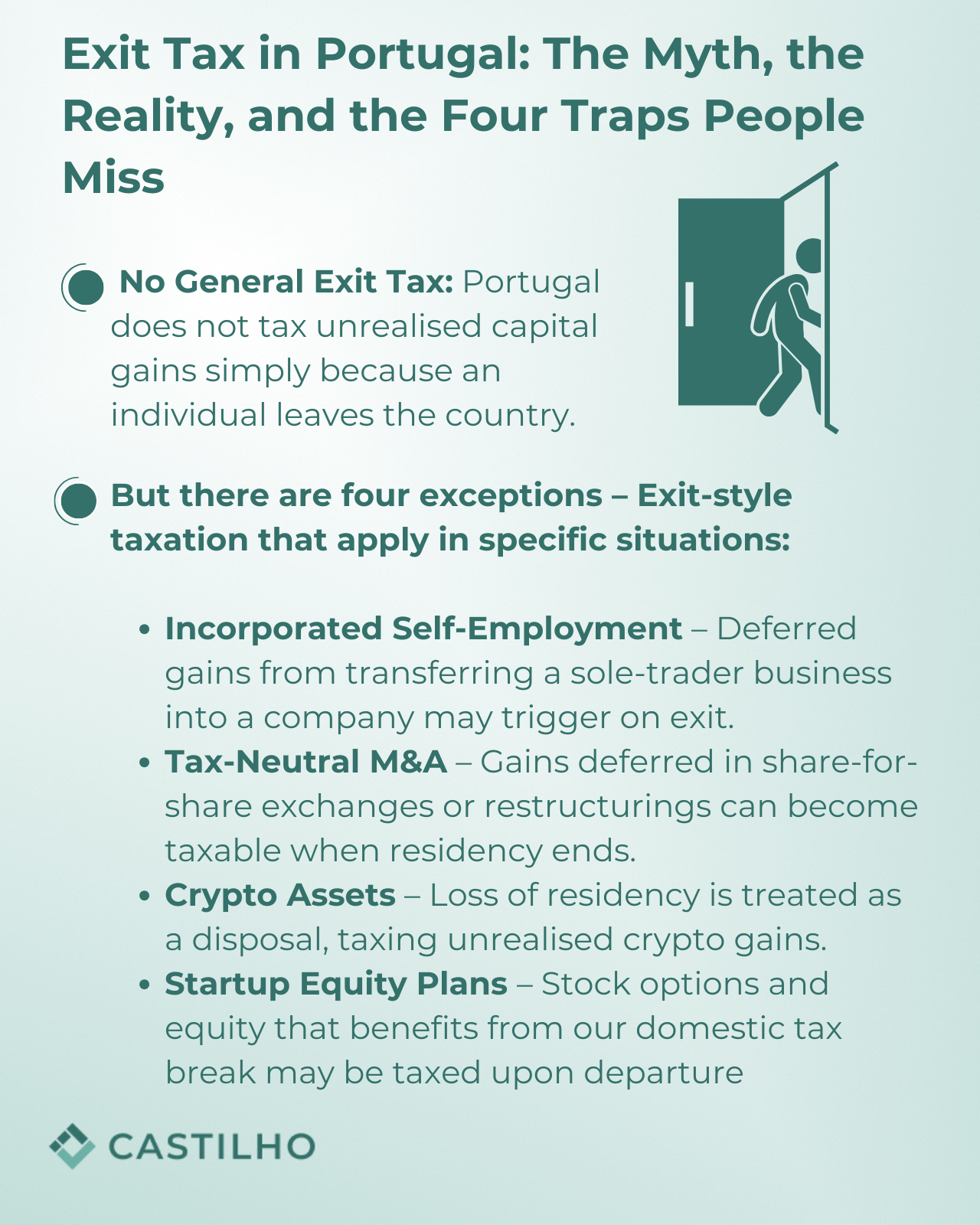
Exit Tax in Portugal: The Myth, the Reality, and the FourTraps People Miss
If you are planning to leave Portugal, you have probablyheard this warning:
“When you leave, Portugal will tax all your unrealisedgains.”
That statement is simply wrong.
Portugal does not have a general exit tax on unrealisedcapital gains for individuals. There is no automatic mark-to-markettaxation when you change tax residency. Shares you still hold? Not taxed. Realestate you have not sold? Not taxed.
However — and this is where planning matters — Portugaldoes have four very specific exit-style taxes, quietly embedded in the taxcode. They do not affect everyone, but when they do, they tend to come as anunpleasant surprise.
First, the Good News: No General Exit Tax
Portugal taxes capital gains only when they are realised.
That means:
- No sale → no capital gains tax.
- No deemed disposal just because you leave.
- No blanket exit tax on securities or real estate.
This places Portugal in a far more exit-friendly position than countries that automatically tax all accrued gains when tax residencyends.
So far, so good.
The Reality: Four “Hidden” Exit Taxes in Portuguese Law
Portugal avoided a general exit tax — but replaced it with four targeted mechanisms that act like exit taxes in very specific situations.
If any of these apply to you, exit planning becomes critical.
1. The “I Incorporated My Business” Trap
Self-employed activity transferred into a company
If you were self-employed and transferred your business into a company under a tax-neutral regime, any built-in gains were deferred— not eliminated.
Portugal is comfortable with that deferral until youleave.
When you lose Portuguese tax residency, previouslyuntaxed capital gains linked to that transfer can crystallise immediately,even if nothing is sold.
There is no new transaction. The exit itself becomes thetrigger.
This rule is designed to prevent permanent deferral through migration.
2. The “Tax-Neutral M&A” Surprise
Share-for-share exchanges, mergers, restructurings
Portugal allows tax-neutral share exchanges and certain M&A transactions. At the time, no tax is due.
But if you later cease to be Portuguese tax resident,the law treats that exit as the moment to tax those deferred gains.
In practice:
- You exchanged shares in a tax-neutral deal.
- No tax was paid at the time.
- You move abroad.
- The IRS may tax the difference between the original acquisition cost and the market value on the date the restructure was made.
Again, this is not a general exit tax — it is a recapture of deferred gains, triggered by loss of residency.
3. The Only “True” Exit Tax: Crypto Assets
Crypto is the clear exception.
Under the current IRS framework, loss of Portuguese tax residency is treated as a disposal of crypto-assets.
What this means in practice:
- Unrealised crypto gains may become taxable even if you never sell.
- Tax is calculated based on market value at exit minus acquisition cost.
- The standard 28% rate may apply, depending on the asset and holding period.
For crypto holders, Portugal does apply a genuine exittax.
4. The Startup Equity Trap
Stock options and equity plans
There is a fourth exit tax that often goes unnoticed — andit affects founders, executives and startup employees.
Portugal provides favourable tax treatment for qualifying SMEand startup stock options and equity plans. Taxation is typically deferred andpartially exempt.
However, loss of Portuguese tax residency is explicitlylisted as a taxable event.
If you leave Portugal while still holding
- Stock options,
- Shares acquired under qualifying startup plans,
- Or similar equity rights covered by this regime,
the deferred gain may become taxable at the moment ofexit, even without a sale.
In substance, this operates as an exit tax on startupequity, designed to ensure Portugal taxes gains accrued while theindividual was resident.
What Portugal Does Not Tax When You Leave
To be clear, leaving Portugal does not trigger taxon:
- Shares or securities you still hold (outside the regimes above)
- Real estate you have not sold
- Ordinary investment portfolios with unrealised gains
These assets remain taxable only upon actual sale,even after you become non-resident (subject to source-state rules).
The Practical Takeaway
Portugal’s exit-tax framework for individuals can be summarised in one sentence:
Realisation-based by default, with four targetedexceptions.
If you:
- Never incorporated a self-employed business,
- Never benefited from tax-neutral restructurings,
- Do not hold crypto,
- And are not covered by startup equity incentive regimes,
then Portugal is one of the most exit-friendly countries in Europe.
If one or more of these apply, exit planning is still perfectly possible — but timing and structure matter.