Portugal: Europe’s Low Key (Wealth) Tax Haven
Portugal’s Low Key Approach to Wealth Taxation
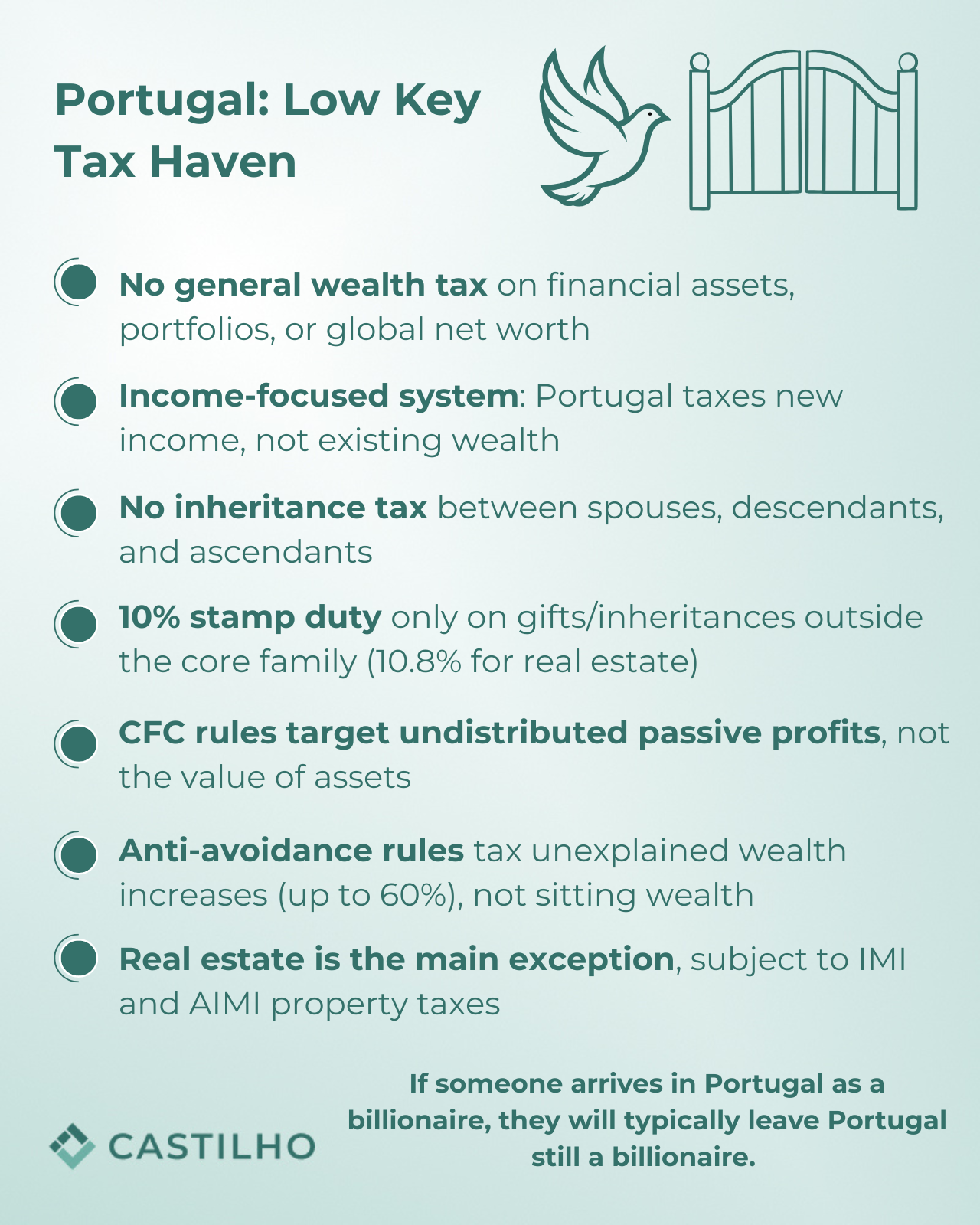
Portugal: Europe’s Low Key (Wealth) Tax Haven
When people think about tax-friendly jurisdictions in Europe, Portugal is rarely the first country that comes to mind. Yet structurally, the Portuguese tax system contains a feature that is surprisingly rare in modern tax policy:
Portugal largely does not tax accumulated wealth.
Instead, the system focuses on taxing the creation of new wealth — meaning income.
This distinction has important consequences for internationally mobile individuals and families with substantial assets.
Portugal Does Not Tax Sitting Wealth
Unlike several European countries, Portugal does not impose a general wealth tax on individuals.
There is no annual tax on existing net worth,regardless of the amount of assets someone holds.
This means there is no annual taxation on:
- Financial portfolios
- Bank deposits
- Private equity or company shares
- Art collections
- Luxury assets
- Global net worth
- Business ownership
A person can therefore move to Portugal already holding significant wealth — even billions — and their existing assets are not taxed merely for being held.
Portugal’s tax system is therefore income-focused rather than wealth-focused.
In practical terms:
If someone arrives in Portugal as a billionaire, they will typically leave Portugal still a billionaire. The tax system will generally only apply to income generated while they are resident.
Even Anti-Avoidance Rules Do Not Tax Wealth
Portugal’s most aggressive anti-tax avoidance mechanisms also illustrate this principle.
One example is the regime addressing “manifestations offortune” and unjustified increases in wealth.
Under this mechanism, if a taxpayer’s visible consumption or asset acquisitions are incompatible with the income they declared, the tax authorities may presume the existence of undeclared income and apply indirect methods of taxation.
Typical indicators include the acquisition of high-value assets such as:
- Real estate
- Luxury vehicles
- Boats
- Aircraft
- Significant financial transfers
These are treated as signals that hidden income may exist,allowing the tax administration to attribute presumed income to the taxpayer.
In the most extreme cases, unjustified wealth incrementsmay be taxed at special rates of up to 60%.
However, the conceptual point is crucial:
These rules do not tax wealth itself.
They tax unexplained increases in wealth, on theassumption that they originate from undeclared income.
Even Portugal’s harshest anti-avoidance rule thereforeremains aligned with the same logic:
tax the creation of wealth, not its mere existence.
Portugal’s CFC Rules Also Target Income — Not Wealth
The same philosophy applies to Portugal’s Controlled Foreign Company (CFC) rules.
CFC rules are designed to prevent residents from accumulating untaxed income through companies located in low-tax jurisdictions.
However, the Portuguese regime does not tax the value offoreign companies or assets held by the taxpayer.
Instead, it only attributes undistributed passive profitsaccumulated in low-tax entities to the Portuguese shareholder for incometax purposes.
Once again, the system is targeting hidden income,not the existence of wealth itself.
No Traditional Inheritance or Estate Tax
Portugal also lacks what most jurisdictions would recognizeas a traditional inheritance or estate tax.
Instead, wealth transfers are generally subject to stampduty, but only in limited circumstances.
Transfers between close family members are fully exempt,including:
- Spouses
- Children and grandchildren (descendants)
- Parents and grandparents (ascendants)
This means that wealth can pass between generations without any inheritance tax.
Tax only applies when transfers occur outside the core family circle.
The Limited 10% Tax on Gifts and Inheritances
When inheritance or gifts occur outside the core family group, Portugal applies a stamp duty of 10%.
If the transferred asset is Portuguese real estate,the rate becomes 10.8% due to an additional surcharge.
Compared with inheritance or estate taxes in many Europeancountries — often ranging between 20% and 55% — this regime isrelatively mild.
Real Estate: The Main Exception
The main area where Portugal does tax wealth-related assets is real estate located in Portugal.
Property ownership may trigger:
- IMI (Municipal Property Tax) – an annual property tax based on the property's taxable value
- AIMI (Additional Property Tax) – a surcharge applicable to high-value residential property holdings
- Stamp duty on property transfers
Even here, the scope is limited:
These taxes apply only to real estate located in Portugal,not to global assets.
The Trade-Off: Portugal Taxes Income
The counterpart to this system is that Portugal taxes income relatively heavily.
Personal income tax rates can reach 48%, plus additional solidarity surcharges.
This means Portugal can be demanding when it comes to newly generated income, especially employment or business income.
But this taxation does not extend to existing wealth.
A Different Fiscal Philosophy
Portugal’s system reflects a fiscal philosophy still found in some Southern European tax systems:
Tax the flow of wealth — not the stock of wealth.
Rather than imposing annual wealth taxes on accumulated assets, Portugal focuses its tax system on:
- income generation
- unexplained wealth increases
- transfers outside the immediate family
For internationally mobile individuals — particularly those with already accumulated wealth — this structure can make Portugal a surprisingly efficient jurisdiction for wealth preservation.