Paid to Stay Still: How Portugal Taxes Non-Compete Compensation
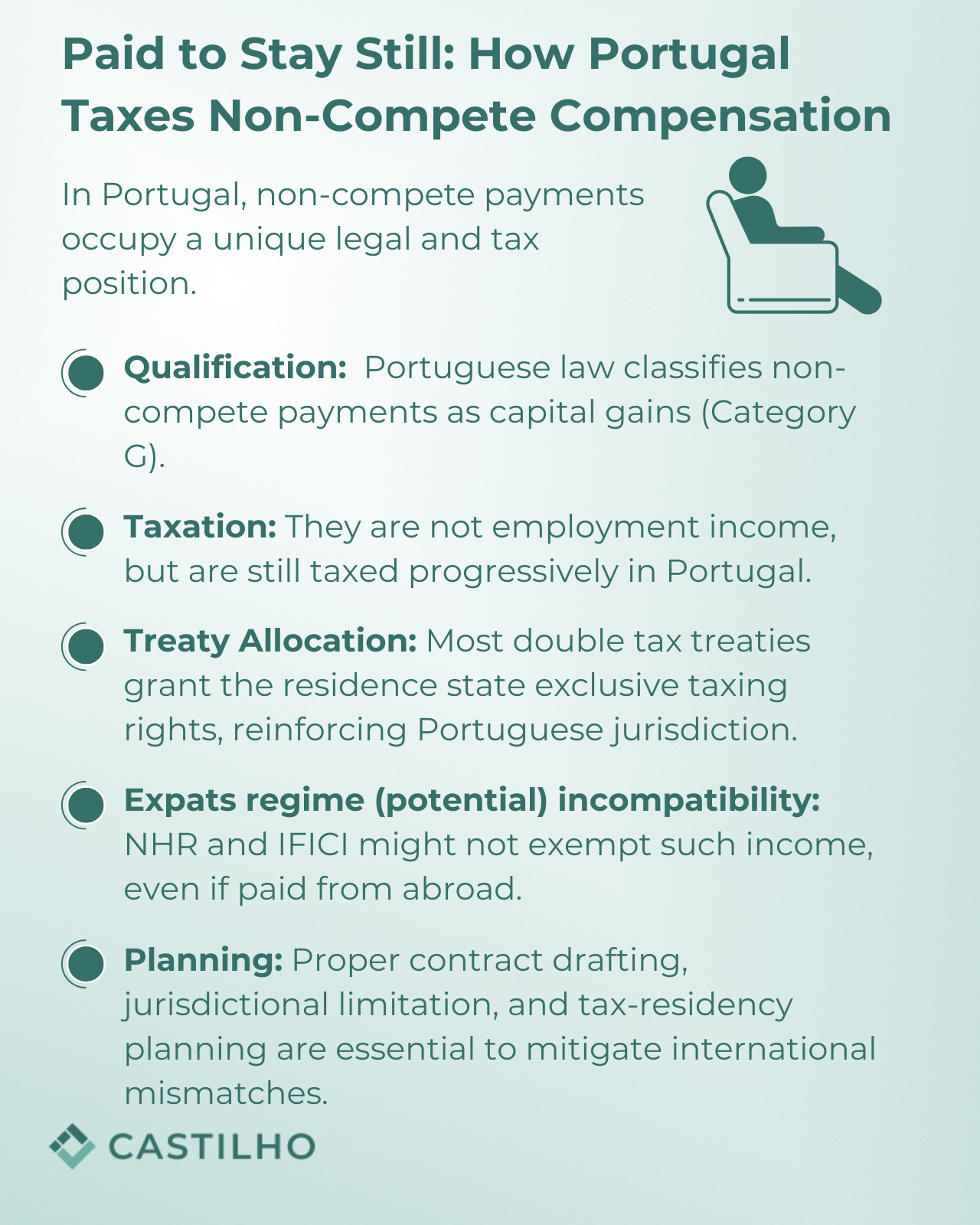
In Portugal, non-compete payments occupy a unique legal and tax position—treated as capital gains rather than employment income, yet often clashing with OECD treaty interpretations.
Various Forms of Income from Inactivity
Payments received by an individual in connection with the suspension or termination of professional activity can take different legal forms. These include stand-by fees, severance payments, sign-onbonuses, compensation for cancellation of employment, sickness benefits, disability allowances, and income derived from non-competition agreements.
Although these forms of remuneration arise in the context of employment or its cessation, they do not correspond to active work performed.Each represents a distinct legal situation:
- Stand-by fees remunerate availability or the obligation to remain at the employer’s disposal without actual performance of work.
- Severance payments compensate the termination of employment, generally reflecting the loss of stability or seniority, and may include statutory or contractual components.
- Sign-on fees are payments granted upon entry into employment, often in recognition of prior commitments or as an inducement to forego competing offers.
- Compensation for cancellation of employment reflects the employer’s unilateral decision to revoke a concluded employment offer or terminate before commencement.
- Sickness and disability allowances substitute employment income when the individual is temporarily or permanently unable to perform work duties.
- Non-competition payments compensate the individual for accepting a restriction on professional activity after termination of employment. The obligation is normally time-limited and may be geographically defined, protecting the former employer’s legitimate interests such as client relations, confidential information, and strategic know-how acquired during employment.
In all cases, the legal qualification depends on the nature of the obligation—whether it concerns work performed, the loss of employment, or the acceptance of a restriction on future activity—rather than on the contractual label chosen by the parties.
Portuguese Domestic Qualification
In Portugal, most forms of income from inactivity—such as severance payments, stand-by fees, sign-on bonuses, or compensation for cancellation of employment—are treated as employment-equivalent income and taxed under Category A of the Código do IRS, at progressive personal income tax rates. These payments are seen as arising from, or connected to, the employment relationship, even if received after its termination.
Non-competition compensation is the main exception.The law classifies it as a special type of capital gain (incremento patrimonial), taxed under Category G. The payment represents the surrender of a personal economic right—the ability to compete—rather than remuneration for work performed. It is comparable to the disposal of an intangible right, similar to compensation for loss of goodwill or future earning capacity.
International Tax Conflicts
Most double tax treaties (DTTs) based on the OECD Model Convention agree with Portuguese domestic interpretation.
According to Article 15 and its Commentary (§2.9), a payment received by a former employee in consideration for an obligation not to workfor a competitor is generally not considered remuneration for employmentactivities performed before termination.
Although such a payment is related to the employmentrelationship, it represents a new contractual obligation undertaken afteremployment ends. For that reason, the OECD Commentary clarifies that it will usuallybe taxable only in the State where the recipient resides at the time thepayment is received.
However, the Commentary also adds an important exception:
“where a payment made after termination of employment is in substance remuneration for activities performed during employment—for example,if the non-compete clause has little or no real value for the formeremployer—the payment should be treated as employment income, taxable in the state(s) where the employment was exercised”.
This duality creates a potential qualification mismatch:
- Portugal treats the payment as a capital gain, taxable under Category G, generally within the residence state’s taxing jurisdiction.
- Other states may classify it as employment income, taxable where the employment was previously exercised.
Hence, when a non-compete clause covers multiplejurisdictions or restricts activities beyond Portugal, double taxation risksmay arise.
In practice, the correct characterization depends on thesubstance of the agreement—that is, whether the payment compensates for pastemployment activity or for a genuine future restriction on professional freedom.
NHR and IFICI Regime Implications
Under both the Non-Habitual Resident (NHR) and Incentive for Scientific Research and Innovation (IFICI) regimes,non-compete payments do not clearly qualify for exemption, even when paid fromabroad, since:
- Most DTTs assign exclusive taxation to the residence state, which in this case is Portugal.
- Under domestic law, capital gains are deemed Portuguese-sourced when they relate to an asset or legal situation located in Portugal.
As a result, non-compete compensation paid by foreign entities is typically taxable in Portugal, as domestic income, at progressive rates, without exemption under NHR or IFICI, unless reclassified under anotherincome category by treaty interpretation.